
June 17, 2026 by Laurie Gwen Shapiro
Well, Hell. Beautiful. Mary Shah and Rachael Wren at Rick Wester Fine Art
No one was supposed to say “beautiful.” Oh God, no. Not in the mid-1990s art scene I knew, when I worked at a then-trendy, high-gloss art magazine and beauty had all the social standing of a shrimp cocktail at a theory seminar. Beauty was too easy and too ready to come in smiling and ruin everyone’s severe little mood. A serious work could resist you from across the room. But beautiful? Beautiful was what your aunt said when she had run out of things to say.
Then I walked into Mary Shah and Rachael Wren’s In the Ecstasy of the Sun at Rick Wester Fine Art and thought: well, hell. Beautiful.
I recently sat down with Shah and Wren, along with their gallerist, Rick Wester, as I was preparing to moderate an artist talk at the Chelsea gallery. At first glance inside the door, the show looked like a conversation between two abstract painters circling landscape and light from different directions. After making my way there via the usual New York racket, the room felt like an oasis, almost indecently calm. Before long, the four of us were talking about Van Gogh, Ansel Adams, Irish farewell songs, hospital walls, and an extinct Hawaiian bird whose last recorded calls can still be heard online. Beauty, it turned out, was not getting out of this exchange alive.
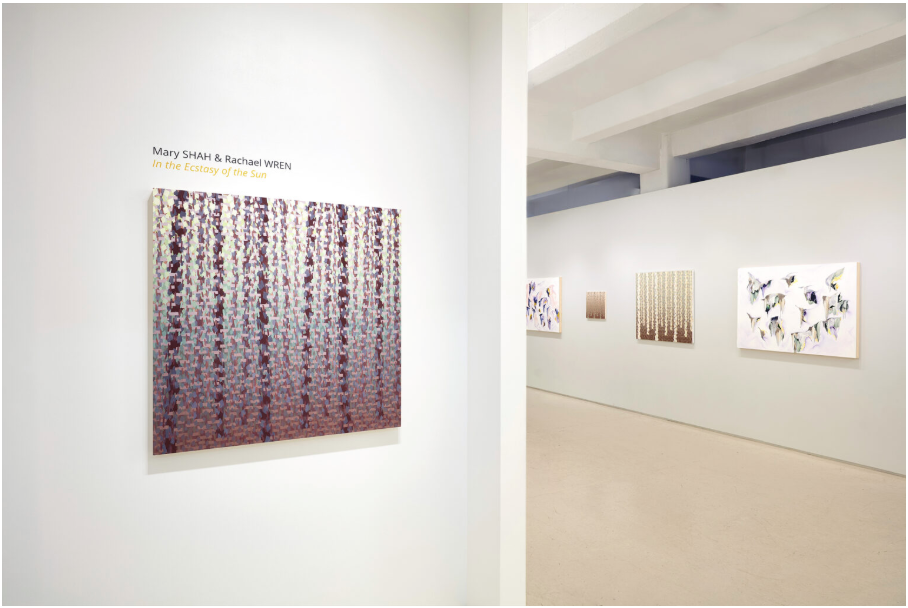
Ecstasy of the Sun, installation view
I quickly learned the title came from Wester, who swears it is not from a poem, though I admitted when I first heard it, I thought it sounded like Emily Dickinson after one small sherry. He laughed and admitted Dickinson had been in his mind recently after working with Amanda Marchand and Leah Sobsey on This Earthen Door, their project drawn from Dickinson’s herbarium and its world of flattened flowers, light, and botanical devotion. For this new show, however, Wester had been thinking about the way Shah and Wren both move between landscape and abstraction, with light doing much of the mischief. The phrase popped into his head, and then he was sure of it. That was that. A good title often shows up like a stray cat and then owns the apartment.
This is the first two-person exhibition at RWFA pairing Shah and Wren. For me at least, too many two-person shows feel like arranged marriages where everyone nods gravely over “materiality.” Here, the paintings do not complete one another; they pester one another into becoming less predictable.
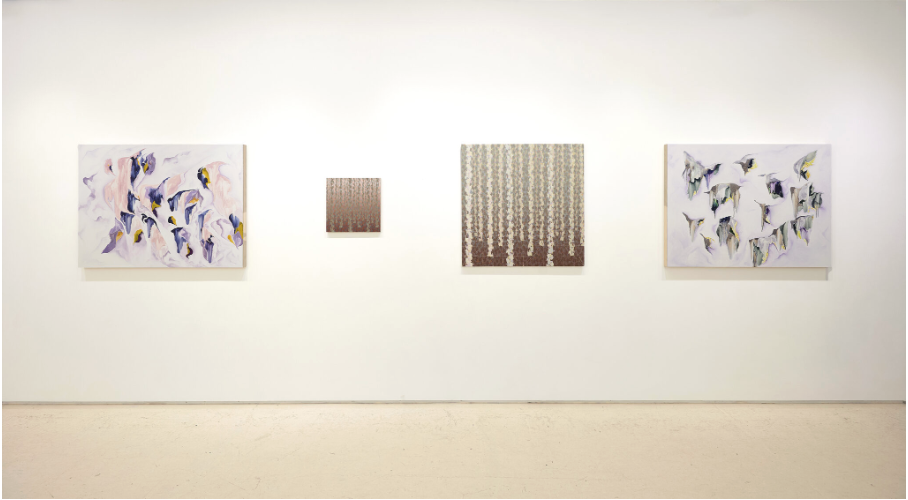
In Ecstasy of the Sun, installation view
When I asked Wren about the geometry in the work, she said she did not treat it as decoration. Geometry was the stern little engine in the room, measuring things and holding the line. Landscape was where the line began to wobble and feeling got in.
In Daydream, oil on paper mounted on panel, Wren lets structure nearly disappear. She told me the work began as a large sheet of Arches oil paper taped to the wall, and that paper gave her a freedom that canvas did not. The painting has horizontal marks and brighter diamond shapes that appear, fade, and seem to return. It does not feel like a place you can visit so much as the afterimage of having been somewhere.
Wren’s work knows that perception is not a camera. Looking is unstable, and color changes depending on what it touches. The eye wants logic, then quietly loses the argument.
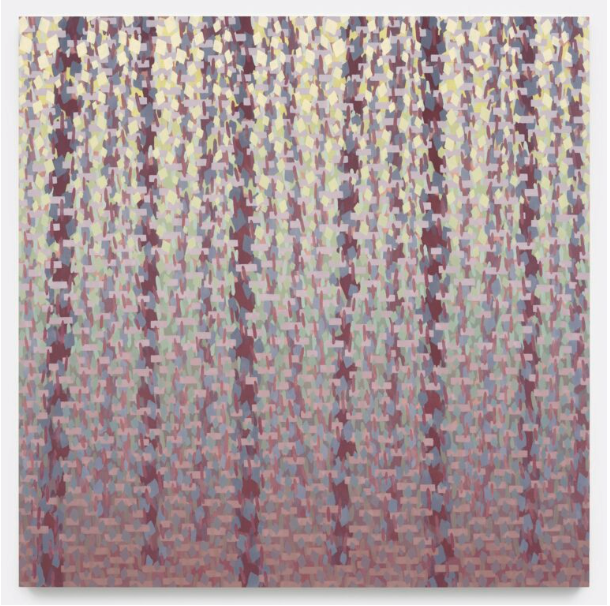
Rachael Wren, Daydream, 2026, oil on paper mounted to panel, 40 × 40 in.
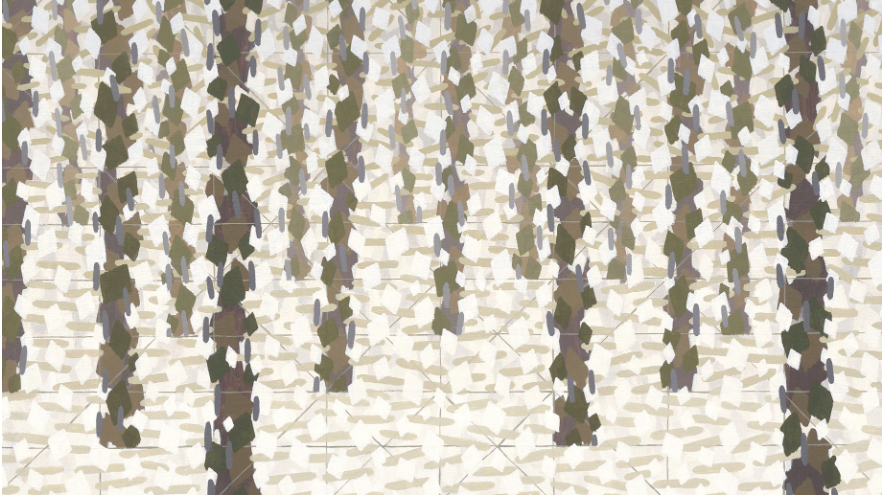
In Uncertainty Principle, that instability gets almost funny in its exactness. Wester pointed out a coppery tone in the painting, but Wren showed me something I would have missed: that in many of her works, the tree-like forms are darker or lighter than the surrounding space. Here, they sit in a middle value, so the fuzziness happens in the middle. Colors that look light at the bottom appear dark at the top because of the surrounding light.
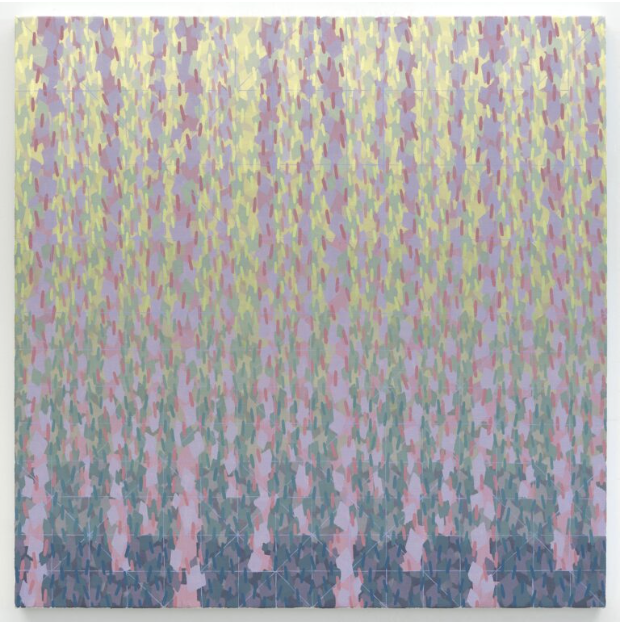
Rachael Wren, Uncertainty Principle, 2025, oil on linen, 36 × 36 in.
This is art-school color theory, but it is also what happens in the woods. You can see at your feet and against the sky. In the middle, everything turns into what Wren called “mush.” I wrote that down with probably too much enthusiasm. Mush is plain and exact. It shooed away a whole paragraph of, erm, art language I might otherwise have written.
Shah told me, and later the assembled panel audience, that she has synesthesia, a crossing of the senses, and that every painting is attached to a song, often one she listens to on repeat while making the work. Sometimes the painting begins with a person in mind; sometimes it begins as a message, or as an imagined place she wants to inhabit. She has called previous works letters, and that makes sense because her paintings seem to be addressed.
The one that got me by the sleeve was Hummingbird’s Lullaby (La Berceuse). Shah connected it to Van Gogh’s La Berceuse, not through color or composition, but through purpose. Van Gogh, Shah reminded me, imagined the woman rocking the cradle as a comfort to sailors and fishermen far from home, people being tossed around on the ocean of life—but Shah wanted to make a lullaby of her own.
A painting as a lullaby can go straight to sugar water, but Shah’s does not. It is luminous and strange. Tender, but not sweet. It seems made for someone who needs comfort and would still throw bad comfort back in your face.
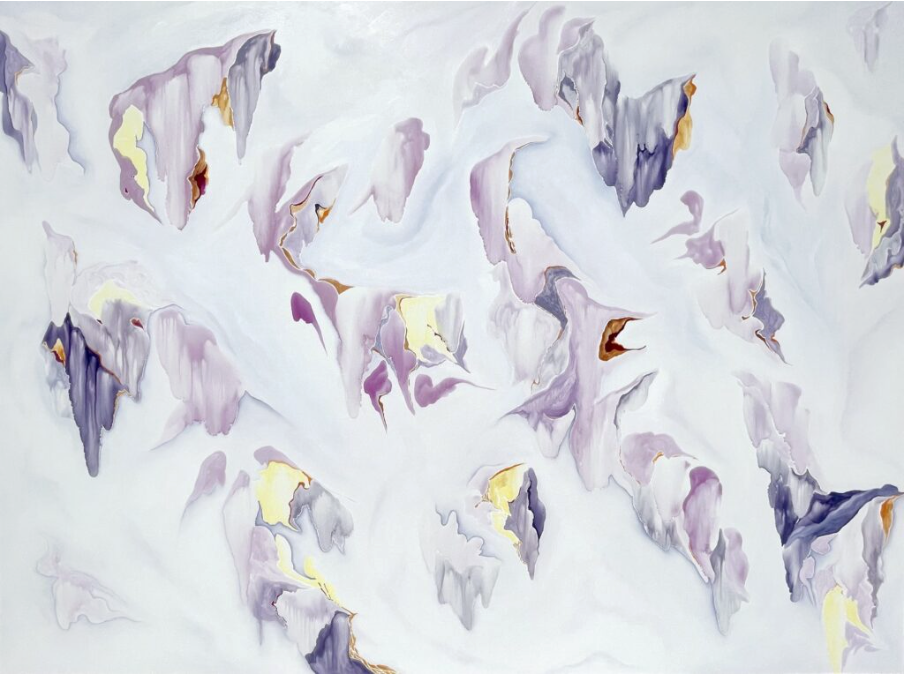
Mary Shah, Hummingbird’s Lullaby (La Berceuse), 2024, oil on panel, 36 × 48 in.
Kauaʻi ʻōʻō works differently. The title comes from an extinct Hawaiian bird. Shah had listened to one of its last recorded calls, and the painting seems to hold that sound without explaining it.
A third Shah painting, Titania’s Nest (For Becka), came from friendship and the 1990s film version of A Midsummer Night’s Dream. When I said the painting had an icy look, Shah laughed and said that meant she had failed. She had not failed. The chill is part of its force. It is a nest, but not a comfortable one; a dream space, but not an escape hatch.
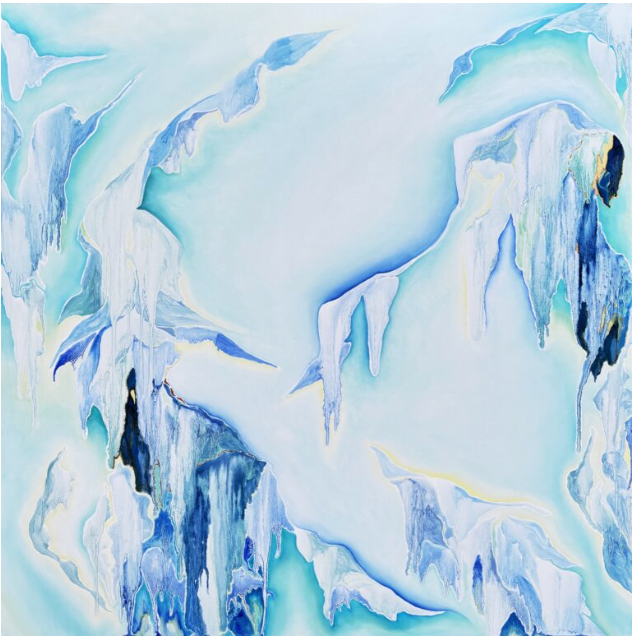
Mary Shah, Titania’s Nest (For Becka), 2026, oil on panel, 30 × 30 in.
The conversation kept circling beauty. Shah said she thinks about it all the time, though in school the word could get you treated like a rube. I get it. Beauty has sold plenty of sofas. But Wren and Shah both make beautiful paintings that refuse to make beauty easy.
Rick Wester’s part in this is simple: he put the two painters in the same room and trusted what happened. Later, during the public talk, artist Debra Ramsay, a member of American Abstract Artists, offered an audience comment that sharpened my understanding of why the pairing worked. Shah’s paintings keep the space close, but they still breathe. Wren’s paintings pull your eye farther back, as if there is more room behind the room. Ramsay called the difference “a pleasant dynamic of opposites.”
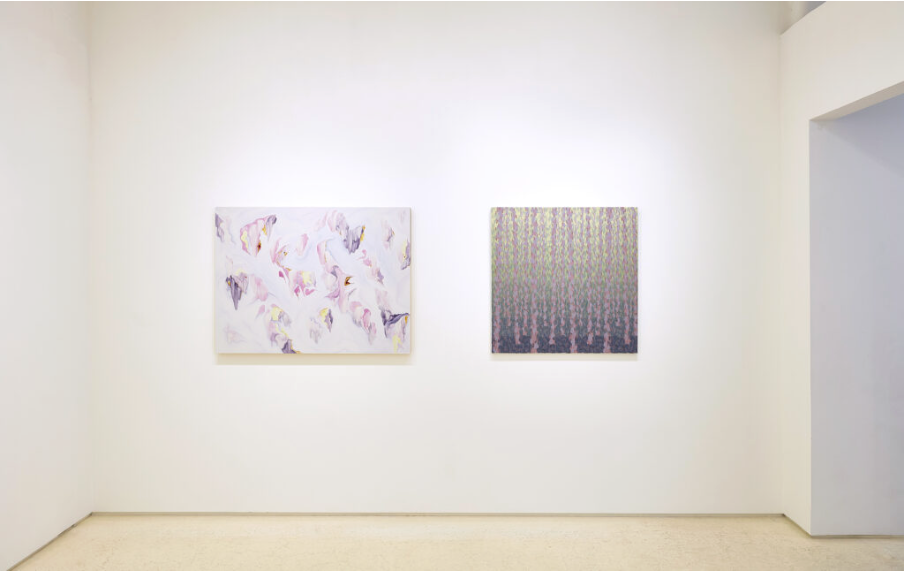
In Ecstasy of the Sun, installation view
Wester called what happens between the two bodies of work “a third entity.” Normally I would back away from a phrase like that before it asked me to read a wall text. But in the gallery, I understood what he meant. The Wren paintings made me look at the Shah paintings differently, and then the Shah paintings sent me back across the room. The landscape would not sit still.
And maybe that is the pleasure of the show. It lets beauty back into the room without putting it in good shoes. Here, beauty can mourn, blur, remember a song, and still — well, hell — be beautiful.
All photo courtesy of the gallery
In the Ecstasy of the Sun: New Paintings by Mary Shah and Rachael Wren remains on view through June 26, 2026, at Rick Wester Fine Art, 526 West 26th Street, Suite 417, New York, NY. Gallery hours are Wednesday through Friday, 11–6; Saturday, noon–6; and Tuesdays by appointment. Instagram: @rwfa_nyc
About the writer: Laurie Gwen Shapiro is the author of The Aviator and the Showman (Viking), about Amelia Earhart, and is currently at work on a new Viking book about Albert Einstein’s extraordinary American years. More at LaurieGwenShapiro.com.